Terry Schooling
I started work at the New Southgate site upon leaving school in June 1954. All was strange for me at that time, although I was soon to find that everything was very different from the school-like environment that I expected.
I was interviewed for the job by a Mr Hart of Personnel, who was blind. It was an invasive interview by most standards, where he would touch me at points during the session, especially on my jacket lapels. Luckily, my Dad had attended the interview, it being my first experience, so I was more at ease than I might otherwise have been. The interview was conducted in Building 2, the factory's personnel office.
When I subsequently received the offer letter, I was instructed to report to the Mailing Department on some future date. This department was on the Top Floor of Building 3. The Mailing Office consisted of a supervisor, a person working at a sorting desk, a number of mailing clerks (each with his large delivery bag) and a small number of office boys, of which I was one.
Opposite the Mailing Office was a row of filing cabinets and beyond these cabinets were mostly females doing typing. One of these was a dark-haired beauty that I came to know was Rita Scheinmann. She was the first love of my life and I made a point of looking for her over the cabinets. If she caught me spying on her, she quickly glanced away with a half-hidden smile. I never once spoke to my darling Rita and lost any possibility of doing so when I left the Mailing Office some months later.
I had to take and collect packages from all over the factory complex, including the Dead File in the basement of Building 8. We had a 3-wheeled barrow in the office that could be steered by standing on the back axle and using each foot on the side wheels to turn corners. One corner that used these skills to the utmost was the curving road from Building 3 to the front of the Canteen/Restaurant (Building 7), which was all downhill.
The Canteen/Restaurant at Building 7 was comprised of a staff canteen and staff restaurant on the ground floor. The Canteen had large, formica-topped-tables in rows - 8 persons to a table if I recall correctly. Slightly more expensive was the Staff Restaurant, with 4-place tables and table clothes. Apprentices were issued with so-called 'dinner disks', each of which would buy a 3-course meal to be eaten in the Staff Canteen.
The grassy hill between Building 3 and the restaurant building was covered with apprentices and clerical girls during summer lunchtimes. You couldn't call it a lunch hour or any variant thereof, because while there were girls on the hill, there were apprentices hanging around them like flies.
My apprenticeship was immediately preceded by my obligatory term in the dreaded Training School, which was housed in the former chapel just outside the South Gate. It was here that Fred Painter (Foreman) and Fred Bedford (Charge Hand) held sway over maybe twenty boys before their apprenticeships began. I know I took several weeks to file square a piece of mild steel to the satisfaction of these two petty tyrants. I was lucky, for I was to get out of their care within three months!
Once out of the Training School, I started my Sheet Metal Work apprenticeship working in the Tool Store of the Sheet Metal Shop in Building 6, run by Ron somebody. The workshop was a small 'half' of the single-storey area inside the building, with the Wood Shop occupying the remainder of the structure.
The Sheet Metal Shop is where I was introduced to the tea ladies. Our regular lady, dressed in a white uniform, came around twice each day to serve tea. The tea would have been dispensed into your own mug. Out in the workshop, gangs of men brewed the gangs' tea using home-made aluminium cans, heated using an open gas flame. Many of these tea ladies were the essence of broad mindedness and several of the green apprentices learned about sex from these gentle females. It was here where I first met Sheila Dowdell, who became a very good friend.
After my time in the Tool Store, I went from workshop to workshop, where I learned new skills. I worked in the vast Machine Shop on the ground floor of Building 3. It was here that screaming lathes, milling machines and drills put out their assigned parts each day, some being operated by skilled operators, while others were controlled by equally skilled Setters and thus operated largely unattended.
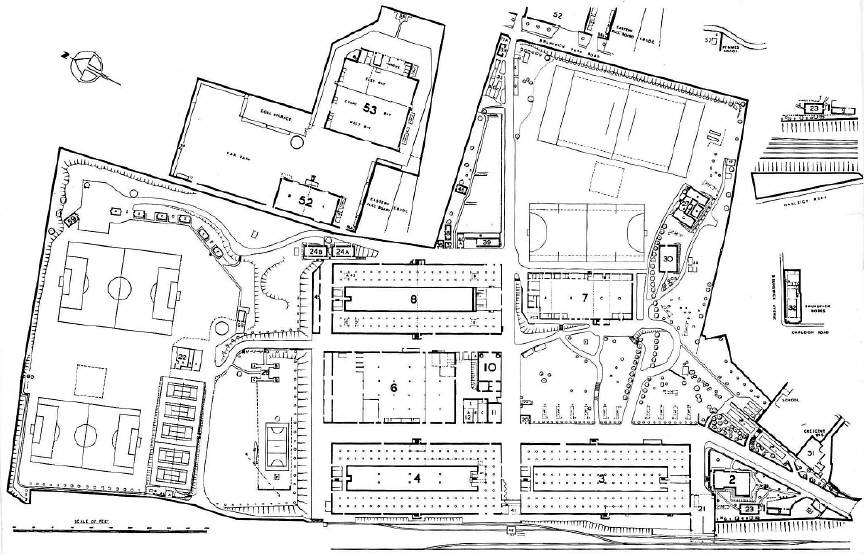
To the south of Building 3 and overhanging the railway track was a covered area, with its substantial roofing fixed high above the entrance to Building 3. Attached to the overhanging roof was a mobile crane, carrying its loads back and forth across the roadway below. When I was in the Mailing Office. a look to the left out of an open window would show the jutting roof of the mobile crane. This area below the high roof and the mobile crane is shown as Room 21 on the plan.
Most of my time during my apprenticeship was spent in the Sheet Metal Shop in Building 6, where I was building larger parts from formed metal (brass, copper, aluminium or steel), to go forward elsewhere to produce larger parts' assemblies. Generally, these smaller parts were made by gangs of men, for the convenience of calculating a cost for each item. In this way, the gangs worked what was known as 'piece work'.
The latter part of my apprenticeship was spent in the Gas Welding Bay in Building 6, where I had taken over from a full-time employee (Bill somebody) who had been badly injured in a motor accident. I had been assigned this job by the Shop Foreman, primarily because I had shown talent for most of the forms of welding carried out in this particular welding bay. Much of the welding was carried out on aluminium, which required the use of a powdered flux to bring about the joining of the metals. The flux residue had to be washed off in boiling water to complete the process.
A lady named May ? worked in the Welding Bay to carry out the metal washing. She, too, left little to the imagination and was often seen to be 'fighting off' workers from the factory floor. I use the term advisedly, because there was really very little 'fighting' on anyone's part.
I was working in this welding bay when I started going out with my first serious girlfriend; one Maureen White. Maureen had been working in one of the commercial sections as a typist when I first started courting her, but she later joined a coil-winding section, where she spent all day making electric coils using the thinnest of wires. Once again, this was piece work, where Maureen was paid as a factor of the number of completed coils she could wind without breakage in a session. Considering coil-winders were sitting side-by-side as they worked, chatting incessantly, the incidence of broken coils was very low.
Another large steel workshop was in Building 8 (2nd Floor?), where I spent a large part of my apprenticeship. I worked in another arc welding shop on this floor, where I learned much more about the practice of arc welding, not least how to carry out the work without getting burned.
Also in this workshop and where I worked for a spell was a lone power press, operated by 'Smokey' Robinson. 'Smokey' was well-named, for if all was going well, he could be heard singing at the top of his voice as he danced around the power press machine. However, if things were not going to plan (his plan), then he could be heard shouting at the machine as he beat it savagely with his large set-up spanner. On these occasions it was advisable to vacate the area, not only so that he would not see you laughing at his antics, but also to avoid any flying objects as a result of his vengeful attacks on his machine.
In my early years with the company, I took advantage of the rifle range to learn how to shoot. I soon tired of the range, probably because I seemed to be the only one among my friends that was interested in shooting off a few rounds. The range itself was sited on a triangular piece of land (Area 39/41 on the plan) alongside the road down to the East Gate. By the time I went off for my National Service, I had forgotten anything I might have learned on the New Southgate range.
On the opposite side of the East Gate road was a large piece of open ground. I think it might have had an athletics track marked on it, because it was where the Annual Sports Day was organised every year. This annual event was well-attended by not only employees of the company but by outsiders as well. If I recall correctly, the Sports Day was followed in the evening by a dance in the Canteen/Restaurant, another event that was never found wanting when it came to numbers attending.
Football and Cricket matches too were held on this large piece of open ground. Football was also played on the so-called "Top Field", which was another largely open piece of higher ground to the north of the site - beyond Building 4.
On the plan, Buildings 52 and 53 are shown as though they were alongside Building 8. In fact, they were within the Main Car Park on the far side of Brunswick Park Road. Building 52 was like one of today's retail sheds, with a corrugated roof covering a large internal area. One time, a fellow apprentice (Ron Bloomfield) and I were given the job of wrecking metal parts using large hammers on the road immediately outside Building 53 (or was it Building 52?). The racket of the hammering reverberated around the interior of the building, resulting in several complaints and requests for Ron and I to find somewhere else to do our banging.
I believe it was in the basement of Building 8 where the Finishing Shop lived. It was here that mostly metal plating of various kinds was carried out. I only worked in the Metal Finishing Shop for a very short time. Just as well, because I am sure I would have finished up doing myself harm. The Shop consisted of a large number of VATS, most carrying out electro-processing largely unattended. I was encouraged by the guy looking after me to first put my hand in one VAT (highly concentrated with a cyanide solution) and then another VAT of similar proportions containing a 5%(?) nitric acid solution. My adviser said the acid would remove the cyanide, so I wouldn't come to any harm. Like a teenage idiot (I think I was 16 at the time), I did what he said without reservation!
In my early years at STC, I would cycle to work at New Southgate from my home in Bounds Green. On entering the South Gate, the triangular area shown to the right of the road on the plan was filled with bicycle racks - hundreds of them! This is where I left my bike each day, where it sat awaiting my return without any problems.
Other people I remember from my time at NSG in the late 50s were:
Brian Moore - friend outside NSG who worked for me as an apprentice in the Sheet Metal Workshop when I was a gang boss.
John Harding - fellow Sheet Metal Work apprentice.
Stan Walker - Apprentices Supervisor
Larry ? - got sacked for selling perfumes, french letters and shampoos from his desk drawer in the Sheet Metal Workshop.
Charlie ? - Chargehand of the Sheet Metal Workshop in Building 6.
Eddie Lacey - Shop Steward for Sheet Metal Workers in the 50s - Buildings 4, 6 and 8.
Alan Nash - fellow Sheet Metal Work apprentice.
Ron Bloomfield - fellow Sheet Metal Work apprentice.
Terry Schooling, January 2022